What does in-situ liquid-phase TEM combined with graph theory reveal about nanoparticle self-assembly?
Jonas Hallstrom, Thomas M. Truskett, Delia J. Milliron, Qian Chen, Xiaoming Mao, Paul Bogdan, Nicholas A. Kotov, and their colleagues from University of Michigan, Ann Arbor and University of Illinois, Urbana recently published their research using the Hummingbird Scientific Gen IV liquid flow TEM sample holder demonstrating how real-time liquid-phase TEM, combined with graph theory analysis, can reveal the dynamic pathways of nanoparticle self-assembly and uncover new principles linking structural complexity to functional nanomaterial behavior. By directly observing hundreds of gold nanoparticles assembling in solution in real time, the team captured transient intermediate states that have traditionally been difficult to quantify, enabling a deeper understanding of how collective nanoscale interactions drive the emergence of functional material architectures.
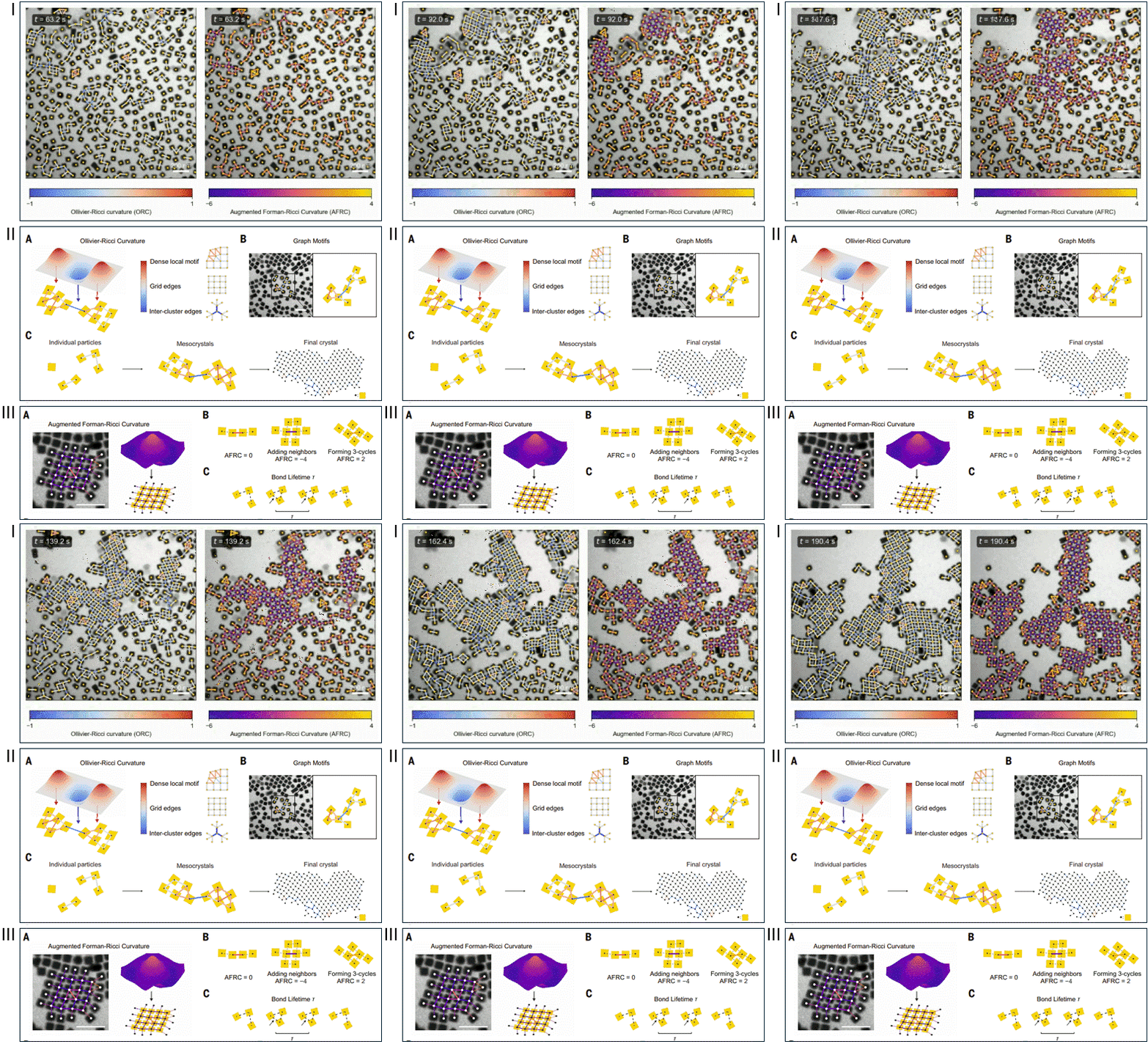
(I) LPTEM movie of gold nanocube transitioning from fully disordered to fully ordered states with overlayed Ollivier-Ricci Curvature (ORC) maps (left) and Augmented Forman-Ricci Curvature (AFRC) maps (right). Scale bars, 200 nm. (II) ORC characterizes the global structural organization of nanoparticle (NP) systems as they transition between disorder and order. (A) Conceptual illustration relating ORC to curvature, where surface height reflects ORC value. (B) Example graph generated from an in-situ liquid-phase TEM image, with edges color-coded by ORC value. Scale bar: 200 nm. (C) Schematic of the multistep self-assembly process. White edges (ORC = 0) indicate regular, ordered structures such as square, rhombic, or hexagonal lattices. Red or positive ORC edges indicate regions with higher local connectivity and more dynamic, complex interactions. (III) AFRC characterizes how easily the nanoparticle (NP) system can reconfigure through local transient 3-cycle states. (A) While 4-cycles represent the stable repeating structure of the fully assembled superlattice, 3-cycles represent less stable, higher-energy configurations that enable structural rearrangement. Surface height reflects AFRC value. Scale bar: 200 nm. (B) Schematics showing different local NP arrangements and the corresponding AFRC values for the highlighted solid edge. (C) Illustration of how edge lifetime (τ) is calculated and related to graph theory metrics. In the LPTEM experiments, edge lifetime is defined as the number of consecutive frames in which two nanoparticles remain connected. Copyright © 2026 The Authors, some rights reserved; exclusive licensee American Association for the Advancement of Science.
Using wide-frame, time-resolved liquid-phase TEM, the team tracked the self-assembly of more than 400 gold nanocubes in solution as they transitioned from freely dispersed particles into ordered superlattices. Advanced image segmentation and graph-based analysis converted each time-resolved TEM frame into dynamic particle interaction networks, enabling the researchers to quantify both local and system-wide structural evolution in real time. By applying newly adapted graph theory metrics including Ollivier-Ricci curvature to capture global connectivity and augmented Forman-Ricci curvature to measure local reconfigurability and energetic state, the team identified distinct assembly stages that conventional symmetry-based order parameters could not resolve. Their analysis revealed a “Goldilocks” regime of intermediate complexity, where partially ordered, dynamically interconnected mesocrystal networks generated the strongest near-infrared plasmonic response approximately 40% higher than either fully dispersed nanoparticles or highly ordered superlattices. Complementary molecular dynamics and kinetic Monte Carlo simulations further validated the experimental observations and demonstrated that this analytical framework extends beyond a single material system. The Hummingbird Scientific Gen IV liquid flow TEM sample holder enabled stable in-situ imaging under precisely controlled liquid flow conditions, making it possible to directly capture these transient nanoscale assembly pathways and opening the door to quantitative design strategies for next-generation photonic, sensing, and functional nanomaterials.
Jonas Hallstrom, Puquan Pan, Jayson Sia, Sangwok Bae, Dingwen Qian, Chang Qian, Sindy Liu, Lehan Yao, Thomas M. Truskett, Delia J. Milliron, Qian Chen, Xiaoming Mao, Paul Bogdan, Nicholas A. Kotov, Decoding collective dynamics and complexity in nanoparticle assemblies using graph theory. Science392, eaeb5134 (2026) DOI: 10.1126/science.aeb5134
Full PaperCopyright © 2026 The Authors, some rights reserved; exclusive licensee American Association for the Advancement of Science.

.png)