.png)

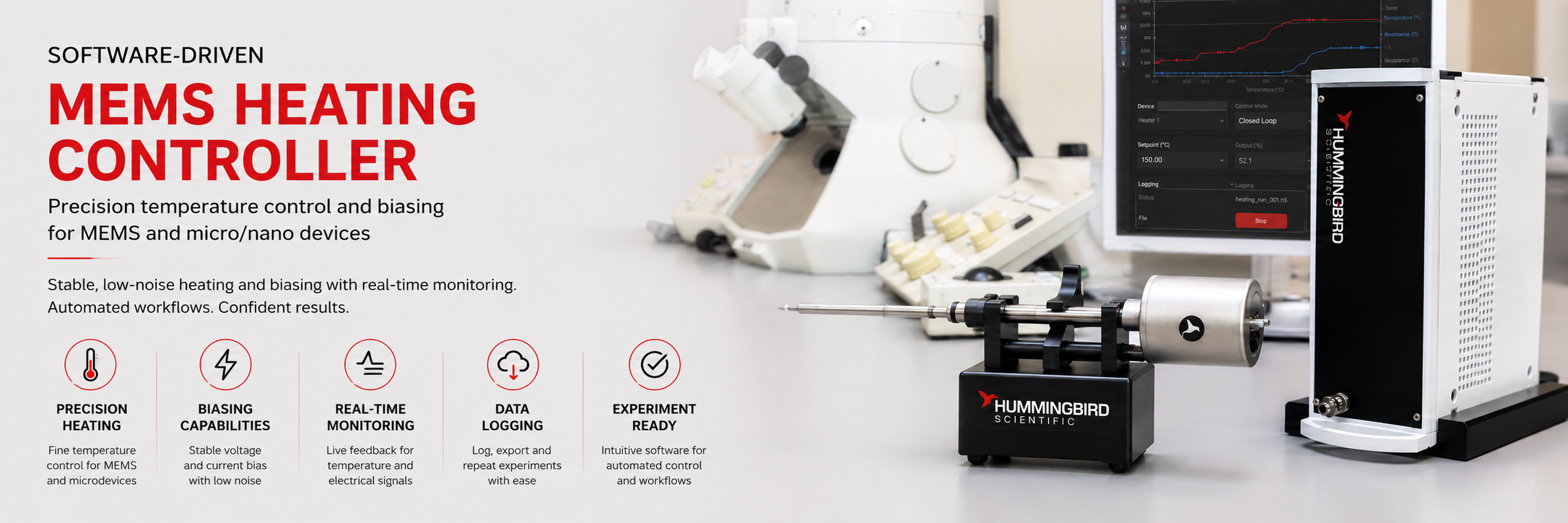
Hummingbird Scientific’s Heating Control Software enables precise temperature control during in situ electron microscopy experiments in standard TEM environments.
The software allows users to define temperature setpoints, maintain stable conditions, and monitor system behavior in real time. Designed for heating TEM holders, it provides a straightforward and reliable platform for controlling thermal conditions during experiments.
Researchers can perform temperature-dependent studies while maintaining accurate and repeatable heating conditions. The system supports both stable operation and controlled temperature changes, making it suitable for a wide range of in situ microscopy workflows.

Hummingbird Scientific’s heating software is purpose-built for in situ electron microscopy, ensuring accurate temperature control and reliable performance.
The software is tightly integrated with Hummingbird heating holders and controllers, enabling precise communication and consistent operation. Users can quickly configure experiments, maintain stable temperature conditions, and monitor results without complex setup.
This integration ensures reproducibility and ease of use, supporting both routine experiments and advanced thermal studies.

The software provides precise control over sample temperature, allowing users to define and adjust temperature setpoints during an experiment.
Users can maintain stable temperatures using automated control or adjust conditions in real time. The system supports starting, pausing, and stopping experiments without interrupting workflow, enabling efficient control during dynamic studies.
This ensures accurate temperature regulation and consistent performance throughout the experiment.
The software supports multiple temperature control modes to accommodate different experimental needs.
Closed-loop mode maintains a stable target temperature through automatic adjustment, while open-loop mode allows direct control of applied power. Ramp mode enables controlled temperature changes over time, supporting time-dependent experiments.
These modes provide flexibility for both steady-state and dynamic heating workflows.
The software allows users to define temperature ramps, specifying both target temperature and the time required to reach it.
This enables controlled heating profiles for studying time-dependent processes such as phase transitions, material behavior, and thermal response. Programmable ramping ensures repeatability across experiments and allows precise control over temperature changes.
This capability is especially useful for experiments that require gradual or precisely timed temperature variation.
The software continuously monitors temperature and displays system behavior in real time.
Temperature data is visualized through live plots, allowing users to observe trends, stability, and transitions during heating. This provides immediate insight into system performance and helps ensure accurate experimental conditions.
Interactive tools allow users to examine both recent data and the full experiment history.
The software is designed to work directly with Hummingbird Scientific heating controllers and TEM holders.
This integration ensures accurate temperature control, reliable communication, and consistent system performance. Users can monitor system status and control experiments from a single interface, simplifying operation and reducing setup time.
Because the software and hardware are designed together, experiments can be conducted efficiently with minimal configuration.

The software records temperature data throughout each experiment, providing a complete time-resolved dataset of system behavior.
Temperature is recorded as a function of time during the entire experiment.
Temperature data is displayed in real time through live graphs, allowing users to monitor both current conditions and long-term trends.
Data can be exported in CSV format for analysis in external tools, and graph images can be saved for reporting and documentation.
Users can reset and record data across multiple sessions, making it easy to compare experiments and analyze results.