.png)

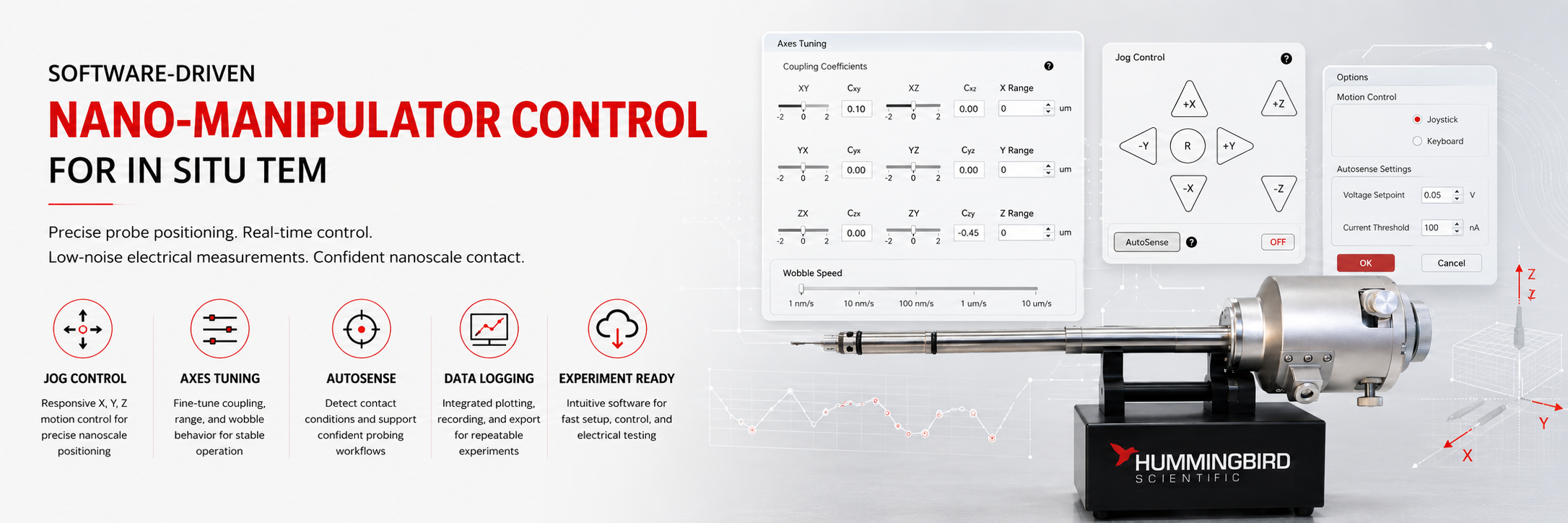
Hummingbird Scientific’s Nanomanipulator Control Software enables precise positioning and electrical interaction with samples during in situ electron microscopy experiments.
The software provides control over probe movement across multiple axes, allowing researchers to position a probe with nanoscale precision. Users can navigate the probe toward regions of interest and establish controlled contact with the sample while monitoring system behavior in real time.
In addition to motion control, the platform supports electrical measurements, enabling experiments such as I–V characterization and conductivity testing. This combination of positioning and measurement allows researchers to directly interact with materials and study their properties at the nanoscale.
Whether performing electrical probing, making contact measurements, or investigating nanoscale behavior, the software provides the precision, control, and feedback required for advanced in situ studies.

Hummingbird Scientific’s nanomanipulator software is specifically designed for in situ electron microscopy, combining precise motion control with integrated measurement capabilities.
The software is tightly integrated with Hummingbird nanomanipulator hardware, ensuring smooth probe movement, accurate positioning, and reliable system response. Users can control probe location, adjust movement speed, and perform measurements from a single interface.
With features such as real-time feedback and automated detection of probe contact, the software simplifies complex nanoscale manipulation tasks and enables more efficient experimental workflows.

The software provides precise control over probe movement across multiple axes, enabling nanoscale positioning within the sample environment.
Users can move the probe in controlled increments or continuous motion, allowing both coarse positioning and fine adjustments. Movement speed and direction can be adjusted in real time, providing flexibility during experiments.
The system supports both manual input and assisted control, allowing researchers to approach, align, and position the probe with high accuracy.
The software supports flexible workflows for both positioning and measurement tasks.
Users can manually control probe movement for precise alignment or perform programmed measurement routines such as voltage sweeps. These workflows support experiments that require both controlled positioning and systematic data collection.
This flexibility enables a wide range of experiments, from simple probing to more advanced electrical characterization.
The software includes automatic contact detection to assist users when bringing the probe into contact with the sample.
During operation, the system monitors electrical signals and identifies when contact occurs, providing immediate feedback through the interface and controller. This reduces the risk of damaging the probe or sample and improves the accuracy of contact-based measurements.
This feature simplifies a critical step in nanoscale experiments, making probe interaction more reliable and easier to control.
The software provides real-time feedback on probe position and electrical measurements during experiments.
Users can monitor current and voltage signals as the probe approaches or contacts the sample, allowing immediate insight into system behavior. Data is displayed through live plots, enabling users to observe trends and changes during measurements.
This real-time visualization helps ensure accurate probe placement and provides feedback during nanoscale interaction with the sample.
The software is designed to work directly with Hummingbird Scientific nanomanipulator holders, controllers, and input devices.
This integration ensures smooth motion control, accurate positioning, and reliable system performance. The software communicates directly with the hardware, enabling responsive probe movement and real-time feedback during experiments.
Because the system is fully integrated, users can control positioning and measurement from a single interface.

The software records electrical measurement data and system parameters during experiments, providing a time-resolved dataset of nanoscale interactions.
The system records current and voltage data, along with time-based information during measurements.
Data is displayed in real time through live plots, including current vs. voltage, current vs. time, and voltage vs. time.
Data can be exported in formats such as CSV or text files for analysis in external tools.
Users can manage measurement data within sessions, enabling multiple tests and comparisons during a single experimental workflow.