.png)

Hummingbird Scientific in-situ holders are built to characterize heterogeneous catalysis, enabling real-time observation of nanoscale catalyst transformations and the direct connection of structure to performance. Multi-modal TEM, SEM, and X-ray experiments can be carried out at pressures up to 2 bar and temperatures beyond 1000 °C without need for drift correction, using ultra-stable cross-compatible microfabricated chips.
Every Hummingbird holder is developed for performance, reproducibility, and ease of use. Scroll down to explore products and the experiments they enable.

Studying catalytic mechanisms requires understanding how materials behave during reactions, where structure, chemistry, and performance continuously evolve. These processes must be observed under realistic reaction environments, while conventional electron microscopy is often limited to pre- or post-reaction analysis, making it difficult to capture these dynamic processes.
In-situ and operando TEM enable direct observation under working conditions. Hummingbird Scientific extends this capability with stable imaging across gas, liquid, and electrochemical environments, and experiments at up to 2 bar and above 1000 °C, allowing catalysts to be studied under realistic conditions with high reproducibility.
Observe catalyst restructuring, degradation, and active-site evolution during reactions under operando conditions, overcoming the limitations of post-reaction analysis and enabling direct identification of activity and deactivation mechanisms.
Correlate nanoscale structure with catalytic activity and selectivity during reactions, linking morphology, composition, and oxidation state directly to performance, which are otherwise difficult to resolve without real-time observation.
Study catalysts under controlled gas and liquid environments at elevated temperatures with stable imaging performance, ensuring behavior can be observed under realistic conditions rather than approximated.
Capture dynamic structural and chemical changes during reactions, including restructuring, phase transformations, and active-site evolution, which are often not accessible through static or ex-situ analysis.

High-pressure gas heterogeneous catalysis
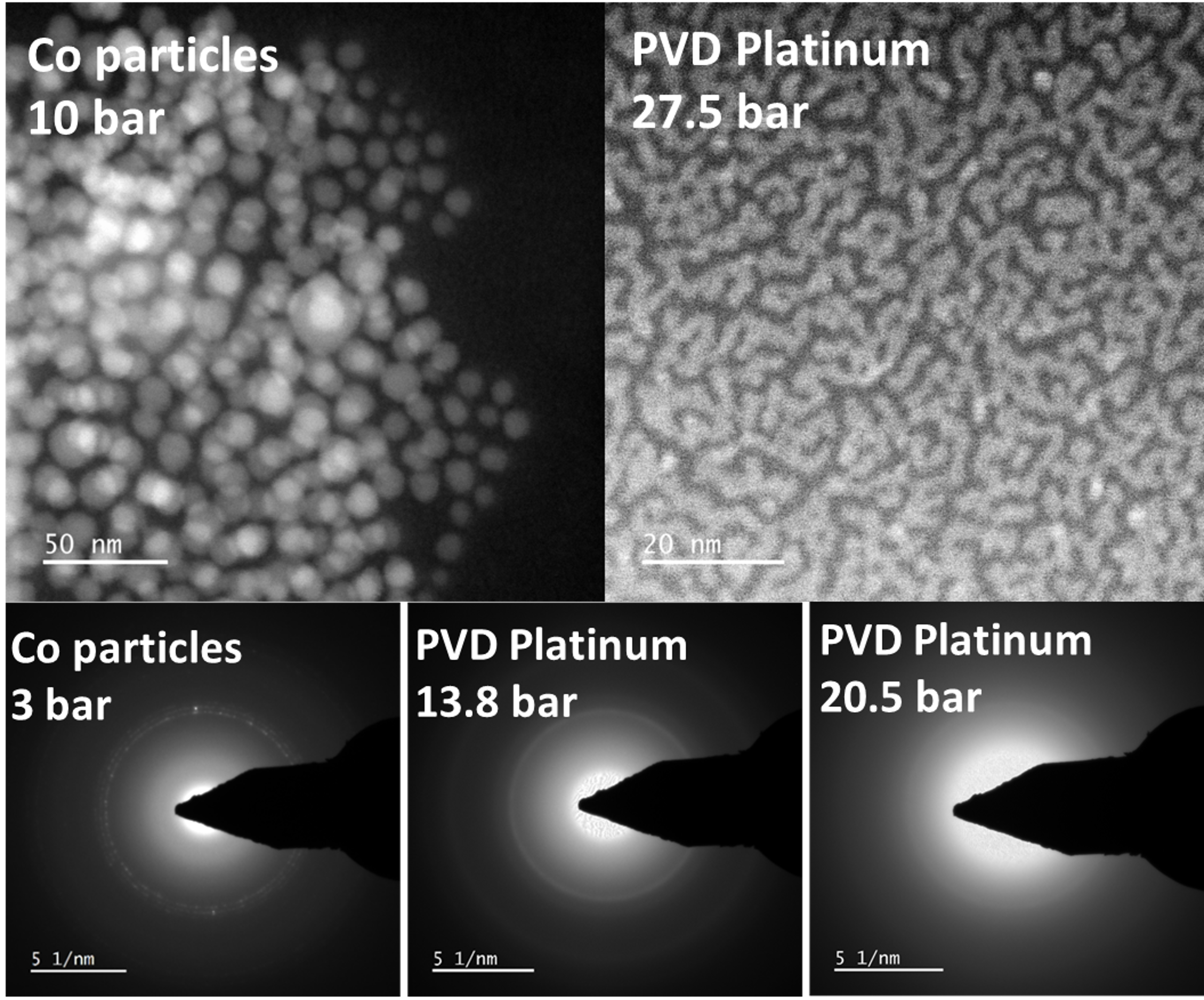
A custom modification of the Hummingbird Scientific gas heating sample holder even enables observation of catalytic transformations in a high-temperature experimental gas environment up to pressures of tens of bar.

High-temperature gas heterogeneous catalysis
Observe in-situ catalytic transformations in experimental gas environments up to 2 bar with heating beyond 1000°C with Hummingbird Scientific gas heating sample holders.

In-situ gas heterogeneous catalyst performance
Link observed structural and chemical transformations to catalyst performance metrics such as activity and selectivity with Hummingbird Scientific gas heating samples holder.

In-situ oxidation and reduction of heterogeneous catalysts
Observe in-situ structural and chemical catalyst transformations under high temperature reduction and oxidation conditions with Hummingbird Scientific gas heating sample holders.

Correlative in-situ heterogeneous catalysis
Observe in-situ catalyst transformations using correlative gas cell TEM, SEM, and synchrotron X-ray microscopy with Hummingbird Scientific gas heating sample holders.

Correlative operando electrocatalysis
Observe in-situ electrocatalyst transformations using correlative liquid cell TEM, SEM, and synchrotron X-ray microscopy.


High-pressure gas heterogeneous catalysis
A custom modification of the Hummingbird Scientific gas heating sample holder even enables observation of catalytic transformations in a high-temperature experimental gas environment up to pressures of tens of bar.

High-temperature gas heterogeneous catalysis
Observe in-situ catalytic transformations in experimental gas environments up to 2 bar with heating beyond 1000°C with Hummingbird Scientific gas heating sample holders.

In-situ gas heterogeneous catalyst performance
Link observed structural and chemical transformations to catalyst performance metrics such as activity and selectivity with Hummingbird Scientific gas heating samples holder.

In-situ oxidation and reduction of heterogeneous catalysts
Observe in-situ structural and chemical catalyst transformations under high temperature reduction and oxidation conditions with Hummingbird Scientific gas heating sample holders.

Correlative in-situ heterogeneous catalysis
Observe in-situ catalyst transformations using correlative gas cell TEM, SEM, and synchrotron X-ray microscopy with Hummingbird Scientific gas heating sample holders.

Correlative operando electrocatalysis
Observe in-situ electrocatalyst transformations using correlative liquid cell TEM, SEM, and synchrotron X-ray microscopy.

Observe in-situ electrocatalyst transformations using correlative liquid cell TEM, SEM, and synchrotron X-ray microscopy.

Observe in-situ catalyst transformations using correlative gas cell TEM, SEM, and synchrotron X-ray microscopy with Hummingbird Scientific gas heating sample holders.

Observe in-situ structural and chemical catalyst transformations under high temperature reduction and oxidation conditions with Hummingbird Scientific gas heating sample holders.

Link observed structural and chemical transformations to catalyst performance metrics such as activity and selectivity with Hummingbird Scientific gas heating samples holder.

Observe in-situ catalytic transformations in experimental gas environments up to 2 bar with heating beyond 1000°C with Hummingbird Scientific gas heating sample holders.

A custom modification of the Hummingbird Scientific gas heating sample holder even enables observation of catalytic transformations in a high-temperature experimental gas environment up to pressures of tens of bar.


In-situ high-temperature ferrihydrite reduction in H2 gas
Although ferrihydrites do not typically catalyze reactions in gaseous environments, multiple transient Fe-based heterogeneous catalysts such as magnetite can be produced by activation of ferrihydrite nanoparticles via hydrogen reduction, with a strong dependence on applied conditions. The TEM Gas Heating holder enables direct connection of applied pressure, temperature, and beam conditions to transient nanocatalyst formation dynamics.
The video shows ferrihydrite nanoparticle reduction to fragmented magnetite in 1.1 bar of hydrogen gas flown into the TEM gas cell. The imaging stability across the temperature range enabled real-time grain restructuring and phase changes of particles from amorphous to a crystalline structure to be captured as the particle was reduced when heated to 360°C in the presence of H2.
Hummingbird Advantage
Reference: Hummingbird Scientific internal data in collaboration with Jaco Olivier, Matthew Coombes, Jan Neethling, Nelson Mandela Metropolitan University, South Africa


Our applications scientists can help identify the right products, experimental workflows, and published examples for your research.